
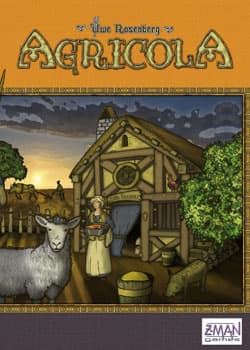
About Agricola
A demanding but deeply rewarding worker placement classic. Expand your farmhouse, raise animals, grow crops, and — most importantly — feed your family at harvest time.
This post contains affiliate links. As an Amazon Associate we earn from qualifying purchases, at no extra cost to you.
Is Agricola Right for You?
Best for
Agricola is for players who relish a tense, tightly constrained worker-placement puzzle. It is at its best with three or four, where the competition for action spaces is fierce and every turn forces an agonising choice. It rewards efficient planning and players who enjoy juggling many small needs at once.
Maybe skip it if…
Skip it if your group dislikes feeling starved; the constant pressure to feed your family and the negative scoring for empty categories can feel punishing and stressful for casual players.
How to Play Agricola
Setup
Each player gets a farmboard with 2 starting family members. Deal 7 occupation and 7 minor improvement cards.
On Your Turn
- Place family members on action spaces (first come, first served).
- Collect resources, build rooms, plow fields, sow, bake bread.
- Feed 2 food per family member at each harvest.
How to Win
14 rounds, 6 harvests. Score farm components — low scores in any category heavily penalised.
💡 Strategy Tips
Get a food engine early or you will starve. Don't neglect fencing.
Common Mistakes to Avoid
- Forgetting that you must feed two food per family member at each harvest or take begging cards, each of which is a brutal minus three points.
- Growing your family too fast without securing the food income to feed the extra mouths.
- Leaving scoring categories empty, since the score sheet penalises you for having zero of a crop, animal, or pasture type.
- Overlooking the fields-to-grain and breeding cycles, which need to be started early to pay off before the game ends.
Advanced Strategy
- Secure a reliable food engine early, such as an oven, a fishing spot, or animals you can cook, so harvests stop being a crisis.
- Read your opening hand of occupations and minor improvements and commit to a strategy they support rather than fighting them.
- Block key spaces, taking an action partly to deny an opponent the action they desperately need.
- Aim to touch every scoring category at least once; filling the last empty slot late is often worth more than piling onto a category you already lead.
Variants & House Rules
Revised Edition (2016)
A streamlined reprint with refreshed art, reworked occupation and minor improvement decks, and clearer iconography aimed at one-to-four players.
Farmers of the Moor
The classic expansion adding heating needs, horses, and forest and moor terrain for a longer, heavier game.
The 5-6 Player Edition / extra decks
Additional action spaces and card decks that support larger counts and add replay variety to the occupation and improvement pool.
Video Guides

Our Verdict
We think Agricola is still one of the all-time great worker-placement designs, a relentless puzzle where there is never enough time or food to do everything you want. It is demanding and can feel mean, so we save it for experienced groups who enjoy a brain-burn. If that is you, few games reward careful planning as richly.
Frequently Asked Questions
How long does Agricola take?
Plan on 30 minutes per player once everyone knows the rules, so roughly 90 minutes for three and over two hours at full count with newer players.
Is Agricola good for beginners?
It is a heavy game with negative scoring and food pressure, so we suggest the family variant (without occupation and improvement cards) for newcomers before adding the full decks.
What is the difference between the original and revised editions?
The revised edition refreshes the art and reworks the card decks for one-to-four players; the original supports five with a separate deck and has the classic card mix.
How important is feeding your family?
It is the heart of the game. Failing to feed two food per person at a harvest forces begging cards worth minus three each, which can wreck your score.