
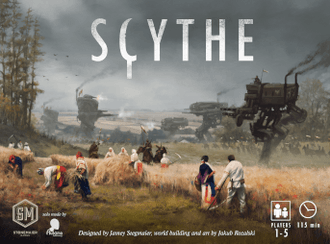
About Scythe
Stunning production, tight design. Lead one of 7 asymmetric factions across a dieselpunk Europe. Manage your action mat, upgrade mechs, recruit workers, and claim territory.
This post contains affiliate links. As an Amazon Associate we earn from qualifying purchases, at no extra cost to you.
Is Scythe Right for You?
Best for
Scythe is for groups that love asymmetry and a gorgeous table without wanting a true war game. Three or four players is the sweet spot, where the map fills up and the threat of combat creates constant tension and negotiation. It rewards efficient engine-building far more than fighting, so it suits players who enjoy optimising a tight set of actions.
Maybe skip it if…
If your group expects a combat-heavy dudes-on-a-map brawl, Scythe will disappoint; most games end with only one or two actual battles, and the rest is quiet economic optimisation.
How to Play Scythe
Setup
Each player gets a unique faction and player mat combo. Place starting workers and mech miniature.
On Your Turn
- Take the top or bottom action of any 2 rows — but not the same row you used last turn.
- Top actions: move, produce, trade, bolster. Bottom: deploy mech, build, enlist, upgrade.
How to Win
Game ends when any player places their 6th star. Score coins, territories, popularity tiers.
💡 Strategy Tips
Your faction's mech abilities define your strategy. Combat is often a bluff.
Common Mistakes to Avoid
- Forgetting you cannot use the same action row twice in a row, which traps players who pick greedily without planning the next turn.
- Underrating the bottom-row build and enlist actions; the recurring bonuses from enlist and structures compound over the whole game.
- Rushing to attack when combat costs power and combat cards and rarely pays off versus just racing to your sixth star.
- Stacking too many resources on one worker-occupied territory, since losing that fight or being trapped behind a river can strand them.
Advanced Strategy
- Plan two turns ahead so the no-repeat-row rule never forces you into a weak action.
- Place your stars deliberately; the game ends the instant someone reaches their sixth, so a player quietly stacking achievements can end it before you are ready.
- In combat, the power and card spend is usually a bluff war; sometimes the cheapest win is retreating and denying your opponent the fight they prepared for.
- Pick faction-and-mat combinations with care, as a strong pairing (like a low-cost mat with a mobile faction) can dictate your whole strategy.
Variants & House Rules
Invaders from Afar
Adds two more asymmetric factions (Albion and Togawa) and supports six and seven players with extra player mats.
The Rise of Fenris
A campaign expansion of linked, story-driven scenarios that introduce new modules and surprises across several sessions.
The Wind Gambit
Adds airships with variable powers and resolution tiles that change the game's end-state conditions.
Video Guides

Our Verdict
We adore Scythe for its production quality and the puzzle of its action mat, but we always set expectations first: this is an economic engine race wearing a war game's clothes. Play it for the satisfying turn-to-turn optimisation and the bluffing tension, not for grand battles. With the right group and Invaders from Afar in the box, it is one of our favourite mid-heavy games to bring out.
Frequently Asked Questions
Is Scythe a war game?
Not really. Combat exists and matters, but most games feature only a handful of fights; the core is racing to place six stars through economic and territorial achievements.
How many players is Scythe best with?
Three or four with the base box. Invaders from Afar extends it to six or seven, but more players means more downtime.
Are the factions balanced?
They are asymmetric and a few faction-and-mat pairings are stronger than others, but most are competitive enough for casual and intermediate play.
Which expansion should I get first?
Invaders from Afar if you want more factions and players; The Rise of Fenris if you want a campaign that evolves the game over multiple sessions.