
About Codenames
Brilliant in its simplicity. Spymasters give one-word clues to guide teammates to the right words — but the assassin lurks among them.
This post contains affiliate links. As an Amazon Associate we earn from qualifying purchases, at no extra cost to you.
Is Codenames Right for You?
Best for
Codenames is the best party game we know for groups of four to eight who want something clever rather than chaotic. It splits into two teams, runs in 15 minutes, and creates those wonderful moments where one perfect clue connects three words at once. It works for word-lovers, families, and office gatherings alike.
Maybe skip it if…
It needs at least four players to sing (two spymasters, two guessers), and it leans on shared vocabulary and cultural reference points — groups with very mixed first languages can find clue-giving uneven.
How to Play Codenames
Setup
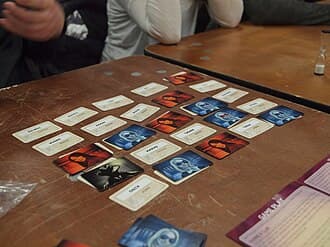
25 word cards in a 5×5 grid. Spymasters share secret key card.
On Your Turn
- Spymaster gives one word + one number.
- Team guesses — one at a time. Stop when wrong or limit reached.
- Teams alternate.
How to Win
First team to find all their agents. Touch assassin = instant loss.
💡 Strategy Tips
Think of clues connecting multiple words while avoiding enemy words.
Common Mistakes to Avoid
- Spymasters giving clues for words their team already guessed, or clueing the wrong number. The number tells your team exactly how many cards to look for — get it right.
- Guessers stopping at exactly the clued number every time. You may guess one extra (a leftover from a previous turn), and sometimes you should.
- Forgetting the assassin. Touching the assassin word loses the game instantly — a single risky clue can hand victory to the other team.
- Over-clever clues. A clue linking four words sounds brilliant but usually sends the team into a wrong or dangerous card. Two solid words beats four shaky ones.
Advanced Strategy
- As spymaster, plan two turns ahead. A clue that sets up next round's connection is stronger than maximising this turn.
- When behind, take risks; when ahead, give safe two-word clues and grind out the win.
- As a guesser, say your reasoning aloud — teammates often catch a dangerous interpretation before you commit.
- Track the opponent's revealed words. Knowing which words are theirs helps you rule out interpretations of your own clues.
Variants & House Rules
Codenames Duet
A fully cooperative two-player (or two-team) version where both sides give clues to each other. The best choice for couples and small groups.
Codenames: Pictures
Uses surreal images instead of words. Easier across language barriers and a different kind of fun — many groups prefer it.
Undercover / single-word-only hard mode
Ban gestures, tone, and "sounds-like" clues entirely. Pure one-word, one-number discipline raises the challenge for experienced groups.
Video Guides

Our Verdict
Codenames won the Spiel des Jahres and deserved it. It is the rare party game that is genuinely smart, plays in minutes, and scales from four to a whole room. We bring it to nearly every gathering. If you own one party game, it should probably be this — or its excellent two-player spin-off, Duet.
Frequently Asked Questions
How many people do you need to play Codenames?
Four is the practical minimum for the classic game (two teams, each with a spymaster and at least one guesser). It scales beautifully up to eight or more. For two or three players, get Codenames Duet instead.
What is the difference between Codenames and Codenames Duet?
The original is team-versus-team. Duet is cooperative — you and your partner (or two teams) both give clues to help each other find all the agents before time runs out. Duet is the better pick for couples and small groups.
Is Codenames good for kids?
The standard edition suits teens and adults (the words assume a broad vocabulary). For younger players, Codenames: Pictures uses images instead and works for the whole family.