
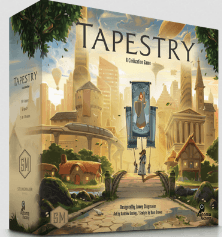
About Tapestry
Stunning production with a unique twist: you advance on 4 separate tracks (Technology, Exploration, Science, Military) and build your capital city. Each civilisation has a wildly unique power.
This post contains affiliate links. As an Amazon Associate we earn from qualifying purchases, at no extra cost to you.
Is Tapestry Right for You?
Best for
Tapestry is for two to five players who want a sprawling civilization feel without a five-hour commitment, advancing along four tracks and building a gorgeous capital city. It shines with players who enjoy wildly asymmetric powers and don't mind a bit of chaos, and the component quality, including the miniature buildings and landmarks, is lavish. Expect ninety minutes to two hours.
Maybe skip it if…
If you want a tightly balanced, tournament-fair civ game, Tapestry's uneven civilizations and big swing powers will frustrate you. It is more a production-rich experience than a finely tuned competition, so balance purists should be warned.
How to Play Tapestry
Setup
Choose a civilisation and capital mat. Place on track starting positions.
On Your Turn
- Advance on any track — gain the space's benefit and possibly an advancement card.
- OR trigger Income turn: collect income, build capital buildings, advance era.
How to Win
After all income turns, score tracks, capital city, tapestry cards, and territory.
💡 Strategy Tips
Don't overextend on tracks — deep in one or two beats shallow across all four.
Common Mistakes to Avoid
- Misplaying income turns; you only collect resources and rejuvenate when you take an income turn, and timing them well is central.
- Advancing on a track before you can afford the next space, then stalling instead of leaping ahead efficiently.
- Forgetting the Tetris-like rules when filling your capital city mat, leaving inefficient gaps that cost income and bonuses.
- Sleeping on your civilization's special power and playing a generic game instead of leaning hard into your asymmetry.
Advanced Strategy
- Plan a few moves ahead on the four tracks so each advance triggers a bonus you can immediately use.
- Build your capital city densely to maximise the income and territory bonuses it unlocks.
- Lean fully into your civilization's power even if it pushes a lopsided strategy; that is where the big scores live.
- Sequence income turns to refresh resources right when you are poised to make several track advances at once.
Variants & House Rules
Plans & Ploys
Adds new civilizations, capital city mats, and tapestry cards, broadening variety in the base experience.
Arts & Architecture
Introduces more civilizations plus landmark and city variety, including new building and scoring options.
Fantasies & Futures
Adds further civilizations and components extending the game's themes into fantastical and futuristic directions.
Video Guides

Our Verdict
We find Tapestry a divisive but genuinely fun spectacle; the asymmetry is unbalanced yet thrilling, and the table presence is unmatched in its weight class. We recommend it to groups who prize feel and replay variety over perfect balance, and suggest the expansions to deepen the civilization pool.
Frequently Asked Questions
Is Tapestry balanced?
Not strictly; the civilizations vary widely in power and some are clearly stronger, which bothers competitive players but delights those who enjoy big asymmetric swings.
How long does Tapestry take?
About ninety minutes to two hours depending on player count and experience.
Can you play Tapestry solo?
Yes, it includes a solo mode against an automated opponent, though most players consider the multiplayer experience the main draw.
Which Tapestry expansion adds the most civilizations?
Each of Plans & Ploys, Arts & Architecture, and Fantasies & Futures adds new civilizations and capital mats; together they greatly expand variety, with Plans & Ploys being a common first pick.